A low asking price can be appealing, but “cheap” Texas land is only a good fit when the parcel works for your plans and the full cost makes sense. A practical buying process starts with your intended use, then moves through records, site conditions, written estimates, and a careful closing. These four steps help you compare land without treating a listing as proof that a parcel is buildable, accessible, or ready for utilities.
Where land costs less in Texas
The Texas Real Estate Research Center tracks rural land prices by region every quarter. Prices per acre are usually lowest in far West Texas and the Panhandle and South Plains, and highest in the Gulf Coast region near Houston and the Austin, Waco and Hill Country region. A low price per acre often means a big tract, so the total price can still be high. On a small budget, the lowest total prices are usually small lots in older lake and rural communities, where a lot can cost under $10,000.
Step 1: Define the use before you shop
Write down what you want the land to do for you: recreation, a future homesite, an RV base, agriculture, long-term ownership, or a development project. Add a time horizon and a realistic budget for both the purchase and later improvements. The same parcel can be suitable for one use and impractical for another.
Turn the goal into a checklist. For any Texas parcel, verify title and recorded exceptions, legal and physical access, zoning or other use controls, deed restrictions, utilities, water and wastewater options, flood and environmental constraints, permits, survey and boundaries, and the exact intended use. County authority varies, and land outside a city is not automatically unrestricted. A city, county, special district, subdivision documents, easements, or other recorded instruments may affect the plan.
Step 2: Compare the parcel, not just the price
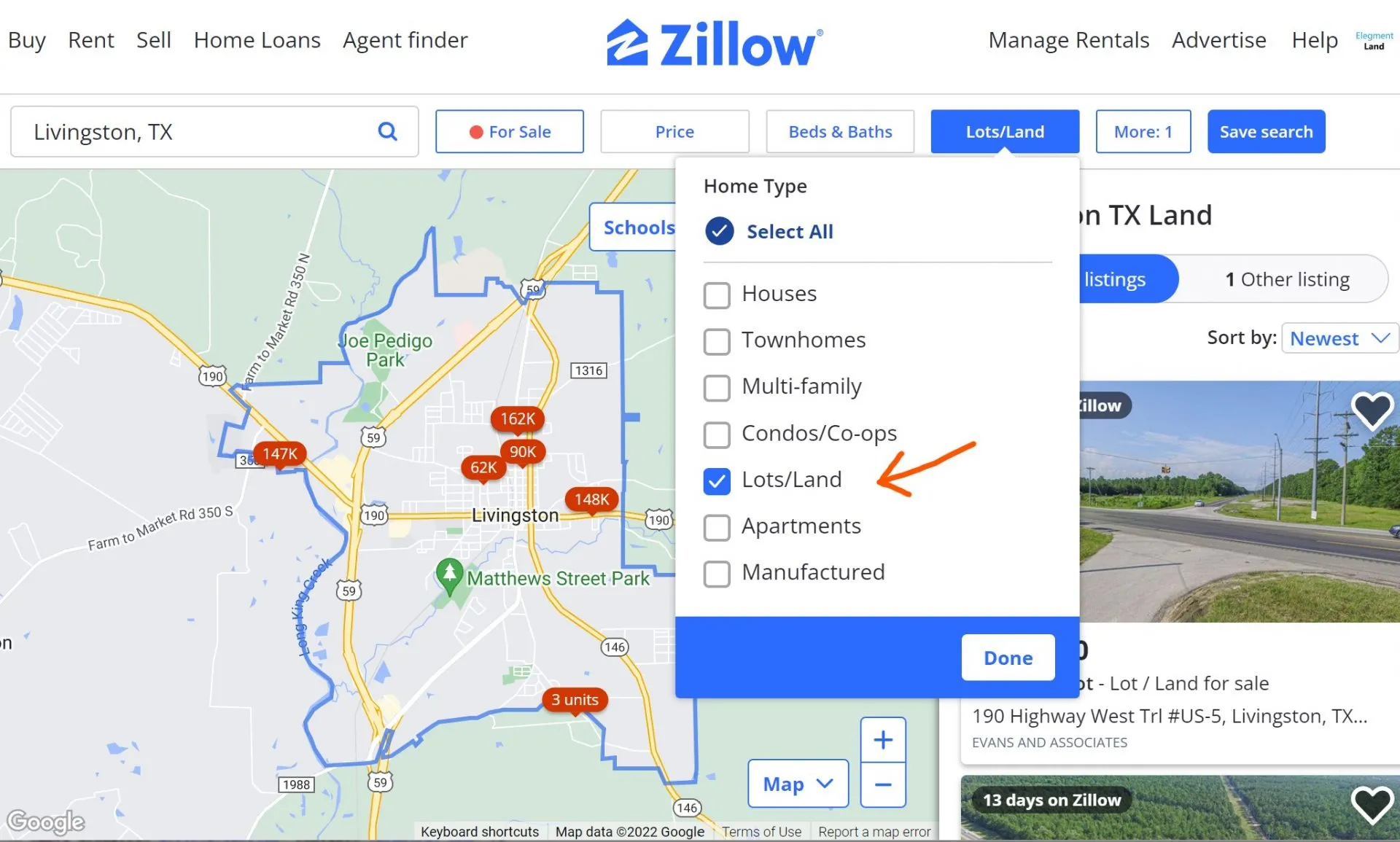
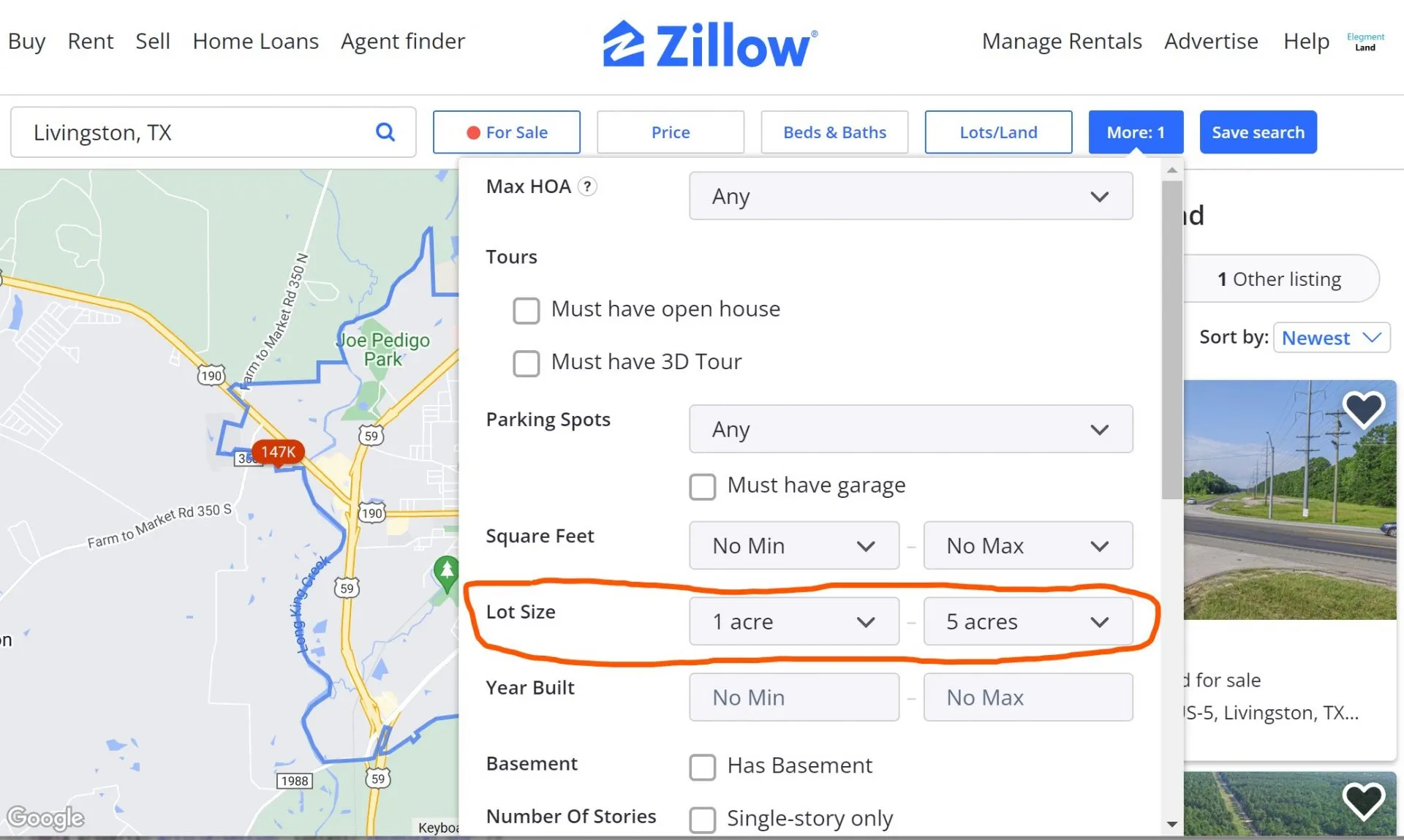
Listing sites and seller inventories can help you build a shortlist, but listing text should be treated as a lead to investigate. Compare location, acreage, road conditions, terrain, nearby services, annual carrying costs, and the likely cost of needed improvements. Use consistent criteria so an inexpensive tract with difficult access or costly infrastructure does not look cheaper than it is.
Review the current county appraisal and tax information, while remembering that the Texas Comptroller says local taxing units—not the state—set property-tax rates. The Texas Comptroller’s property-tax resources direct parcel questions to the local appraisal district or tax assessor-collector. Ask about current taxes, delinquent amounts, exemptions or special valuation history, and any rollback or change-of-use consequences that may be relevant.
Look at physical constraints early. FEMA identifies its Flood Map Service Center as the official source for National Flood Insurance Program mapping products, but a map is a screening tool rather than a site elevation or drainage study. USDA’s Web Soil Survey provides current official soil-survey information for a selected area. Soil maps can guide questions, but they do not replace an on-site septic evaluation, geotechnical work, or other professional testing.
Step 3: Verify access, services, and feasibility
Confirm that the legal description matches the land you expect to buy. Review a current survey when appropriate and trace legal access through the title commitment, recorded easements, plat, and road records. Visible tire tracks or adjacency to a road do not by themselves establish legal access. If a new or modified driveway would connect to a state highway, TxDOT explains that a permit is required before work begins in the highway right of way.
Ask each utility provider for written availability and cost information tied to the parcel. For private water, nearby well records can be useful context; the Texas Water Development Board groundwater database includes selected well, water-level, and water-quality records, but warns users to check accuracy and suitability. A nearby well does not establish that a new well will have the same depth, yield, or water quality.
For wastewater, do not assume a parcel can support septic. TCEQ says an on-site sewage facility generally requires a permit and approved plan and recommends a preconstruction site evaluation; the local permitting authority can apply stricter requirements. Confirm setbacks, soils, usable area, system type, and cost before relying on septic in your budget.
Step 4: Price the whole project and close carefully
Build a total-cost worksheet that includes purchase price, title and closing charges, survey, taxes, road or driveway work, clearing, drainage, power extension, water, wastewater, permits, insurance, maintenance, and a contingency. If financing is involved, compare the written term, interest rate, payment schedule, balloon provisions, late charges, prepayment terms, and total cost. Do not assume a fast closing is safer or less expensive.
Before funding, read the contract and title commitment. The Texas Department of Insurance explains that a title commitment lists potential issues, exceptions, and exclusions, and recommends comparing the policy’s legal description with the survey. Use a licensed title company and seek legal, survey, engineering, environmental, or tax advice when the facts call for it.
The best outcome is not the lowest sticker price. It is a parcel whose verified facts, total cost, and limitations fit your intended use, with enough financial room to handle maintenance, delays, and reasonable changes to the plan.
When you are ready to compare active options, browse current land listings and apply the same checklist to every parcel.
Working with a tight budget? See our cheap land for sale, with lots under $10,000.
Official resources
- Texas Department of Insurance: Title insurance FAQ
- Texas Comptroller: Property Tax Assistance
- TCEQ: Getting a permit for an on-site sewage facility
- FEMA: Flood maps
- USDA NRCS: Getting started with Web Soil Survey
- Texas Local Government Code Chapter 211: Municipal Zoning Authority
- Texas Local Government Code Chapter 232: County Subdivision Regulation
- Texas Real Estate Research Center: Texas Rural Land Markets