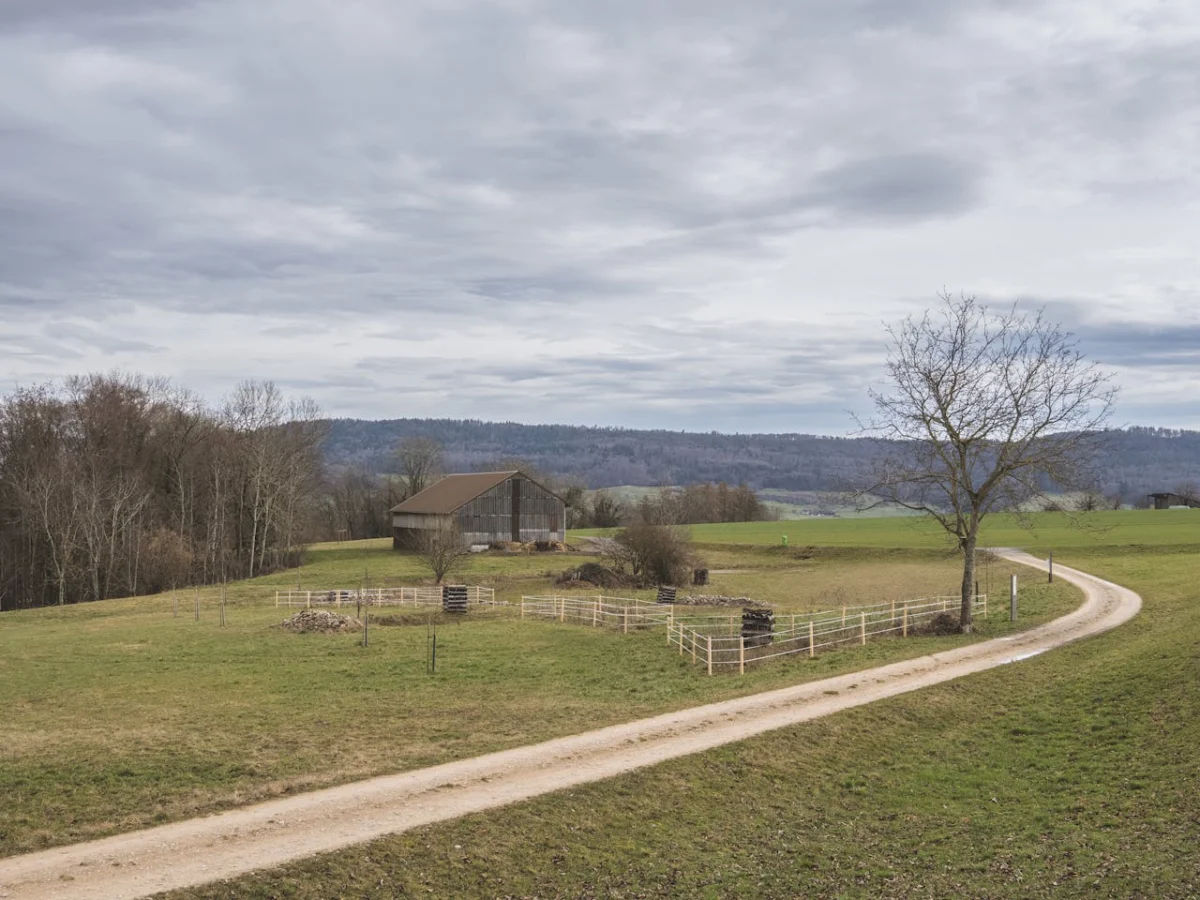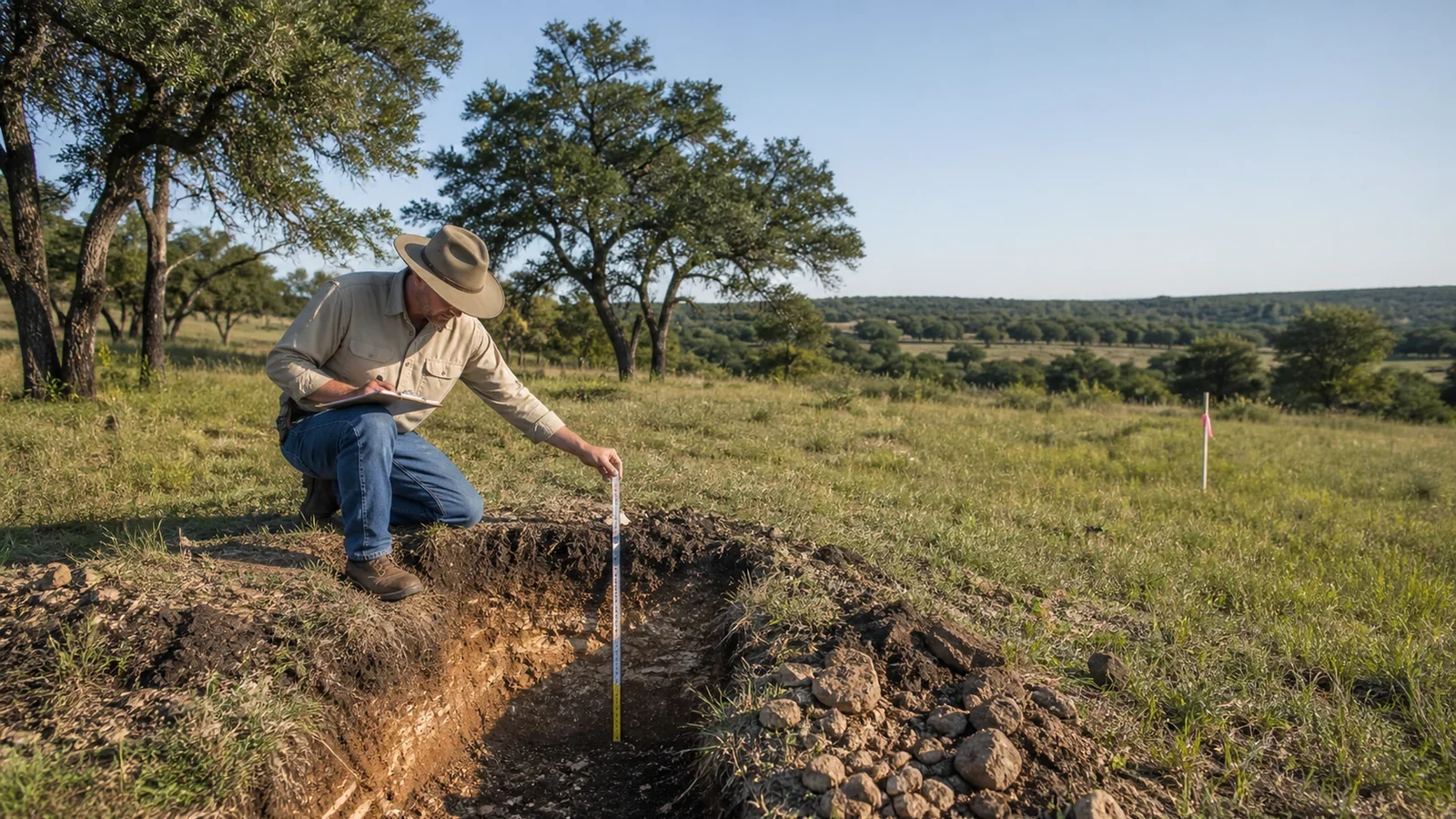
Direct answer: there is no single minimum lot size that makes raw land septic-ready in Texas. Acreage alone never establishes feasibility. Approval depends on the proposed wastewater flow, soil and site evaluation, lot dimensions, setbacks, wells and water lines, groundwater or restrictive layers, slope, drainage, flood conditions, structures, easements, and enough usable area for the approved disposal method and any locally required replacement area.
This is a Texas guide to on-site sewage facilities (OSSFs). It does not state the rules for Arkansas, Ireland, or any other jurisdiction. Before buying or designing improvements, identify the Texas permitting authority for the exact tract and obtain the parcel-specific evaluation it requires.
1. Confirm sewer service and the Texas authority
Ask the city, utility, or district whether public sewer serves the tract, whether connection is available or mandatory, and what extension, tap, capacity, easement, and road-work costs apply. If sewer is unavailable, use TCEQ’s OSSF permit guidance and local-authority lookup.
TCEQ states that a permit and approved plan are required to construct, alter, repair, extend, and operate an OSSF, subject to limited exceptions. TCEQ often is not the permitting authority; local authorized agents administer many programs and can be more stringent than state minimums. Ask which rules apply, who may evaluate, design, install, inspect, and maintain the system, and what must occur before construction.
2. Define use and design flow
Give the authority an accurate plan: residence size and bedrooms, RV connections, accessory dwelling, shop plumbing, short-term rental, multiple units, or future subdivision. A system sized for one residence should not be assumed adequate for additional RVs or later buildings.
On a current survey or site plan, locate property lines, proposed buildings or pads, wells, water lines, easements, drainage, floodplain, slopes, roads, utilities, and potential primary and replacement disposal areas. Do not commit to a building location before an accepted wastewater professional identifies usable space.
3. Obtain the required site evaluation
TCEQ says a site must be evaluated before an OSSF can be constructed, installed, altered, extended, or repaired. Its system-selection guidance ties suitability to site-evaluation results, including soil texture or fractured rock, groundwater, restrictive horizons, slope, and flood-hazard planning.
Arrange the evaluation through a licensed site evaluator or licensed professional engineer accepted by the authority. A “perc test” may not be the complete or controlling procedure, and a favorable preliminary observation is not a permit. If septic feasibility matters to the purchase, make the due-diligence period or contingency match the authority’s actual process and define an acceptable result.
4. Match a design to the evaluated tract
Conventional gravity disposal may suit some sites; others may require low-pressure dosing, chambers, aerobic or other secondary treatment, drip dispersal, mound, or another approved approach. The correct system and cost cannot be selected from acreage or a national price table.
Obtain a parcel-specific design and written estimate covering treatment and disposal components, excavation and rock work, pumps, controls, electricity, alarms, access, inspections, grading, and local standards. Also price recurring obligations such as pumping, service contracts, testing, disinfection, electricity, vegetation management, reporting, and replacement parts.
5. Apply, install, inspect, and obtain authorization
Follow the permitting authority’s sequence. Do not begin work before authorization to construct, cover components before required inspection, or occupy or connect the system before final authorization. TCEQ maintains current licensing information for Texas OSSF roles. Verify each professional’s current credential, insurance, scope, exclusions, references, warranty, and responsibility for permitting and inspection coordination.
The limited Texas ten-acre permit exception
Texas Health and Safety Code Section 366.0515 describes limited conditions under which a permit may not be required for an OSSF serving a single-family residence on a tract of ten acres or more. Every statutory condition must be satisfied, and TCEQ tells owners to confirm with the local permitting authority.
This is not a rule that “ten acres guarantees septic” or that every ten-acre tract needs no permit. The exception may not fit an RV, multiple residences, a subdivided tract, an installation near a boundary, or other facts outside the statute. It does not establish soil suitability, design approval, absence of nuisance, water availability, buildability, or compliance with other public and private requirements.
Budget and protect the purchase
Build the budget from local written quotes: authority fees, site evaluation, survey or site plan, design, equipment, excavation, rock work, pumps, controls, electrical work, disposal area, inspections, grading, maintenance, and a replacement reserve. Include contingency for redesign or advanced treatment.
Before closing, consider a due-diligence period or contingency that permits the required evaluation and authority review. State who pays, whether the seller must allow access, what documents must be produced, what result is acceptable, and what happens if no approvable or affordable design is found. Use qualified Texas real-estate, legal, engineering, surveying, and OSSF professionals as appropriate.
Parcel and site limitations to keep in view
- A large tract can still have too little usable area after setbacks, easements, flood conditions, slopes, rock, groundwater, and planned improvements are considered.
- A neighboring system does not prove that the subject tract has the same soil, slope, groundwater, usable area, design flow, or approval path.
- An old perc result or seller statement is not current authorization.
- Changing the number of bedrooms, adding RVs or another dwelling, moving structures, or subdividing can change the design and approval.
- An existing tank or hookup needs permit, capacity, condition, inspection, and maintenance records; its presence does not prove lawful or adequate service.
A difficult site is not automatically impossible, and acreage is not approval. The defensible answer comes from the current Texas authority, a compliant parcel-specific evaluation and design, required authorization, and a budget for installation and continuing operation.
Coordinate wastewater with the tract’s other infrastructure using our RV-lot utilities guide.
Want water and power already at the road? See our land for sale with utilities.