We’ve been selling land since 2016, to more than 800 buyers, and we developed Murphy’s Dairy Ranch near Mexia, where the pasture is still leased for cattle grazing. So we’ve watched a lot of people do cow math on a napkin.
The napkin math always goes the same way. Acres divided by cows equals a herd, and by the second cup of coffee the herd has names. Texas grass has its own opinion about that math, and it mostly depends on how much rain fell last year.
How many acres per cow do you need in Texas?
Texas needs anywhere from about 3 acres per cow to more than 200, depending on where the land sits. In the Post Oak Savannah and Blackland Prairie, Texas Parks and Wildlife (TPWD) puts one cow with her calf at 8 to 15 acres of native grass. On tame pasture, it’s 3 to 6 acres. West of there, the acres per cow climb with every inch of rain you lose.
| Region | Native range (acres per cow) | Tame pasture (acres per cow) | Source |
|---|---|---|---|
| Post Oak Savannah and Blackland Prairie (incl. Limestone County) | 8 to 15 | 3 to 6 | TPWD |
| Gulf Prairies and Marshes (coast) | 10 to 20 | 3 to 6 | TPWD |
| Eastern Edwards Plateau and Cross Timbers | 15 to 20 | Not listed | TPWD |
| Central Edwards Plateau and Cross Timbers | 25 to 35 | Not listed | TPWD |
| Far west Edwards Plateau | 40 to 50 | Not listed | TPWD |
| South Texas, sandy loam range | 14 to 21 | Not listed | Texas A&M |
| Trans-Pecos (far West Texas) | 75 to 200+ | Not listed | TPWD |
Each range is for one animal unit, about a 1,000-pound cow with her calf, grazing all year. Limestone County sits in the Blackland Prairie on TPWD’s county list, and wooded ground in that region carries far less: about 50 to 75 acres per cow. The South Texas figure runs from range in excellent condition to range in fair condition.
Notice that the far west end of the Edwards Plateau needs more than twice the land of its eastern edge. Same region, same cows, wildly different lunch portions. Tame pasture means planted grass that someone fertilizes and fusses over. Native range is whatever came up on its own, which is tougher and cheaper and far less generous.
Still working out how much land you want in the first place? Our guide to what a ranchette is and how many acres it takes covers the bigger picture. This post is about the cows.
What is an animal unit for cattle?
An animal unit is a mature 1,000-pound cow and her calf. According to Texas A&M AgriLife, it eats about 26 pounds of forage a day, or 9,490 pounds a year. Texas stocking rates are written as acres per animal unit, so a bigger animal counts as more than one. AgriLife lists an 1,800-pound bull at about 1.7 animal units and a 500-pound stocker calf at about 0.6 in its small acreage guide.
That 26 pounds is dry weight, measured like hay. So a cow eats roughly the weight of a toddler in dried grass every day, then looks at you like you forgot dinner.
Here’s the part that trips people up. The old rule is “take half, leave half,” but AgriLife points out that trampling, decay and insects claim about a quarter of each year’s growth. That leaves only about 25 percent of the grass for the cow. The missing quarter gets stepped on, rots, or feeds grasshoppers who have never once offered to help with the mowing.
Run the numbers on an acre that grows 2,000 pounds of forage a year. The cow gets about 500 pounds of it. She needs 9,490, so that pasture takes about 19 acres per cow. The survey says you own 10 acres. The cow reads the grass, not the survey, and she grades hard.

How many cows can you keep on 3, 5 or 10 acres?
On 3 to 10 acres in Texas, most owners can carry one to a few cows only by feeding hay for part of the year, and sometimes all of it. Texas A&M AgriLife says small acreage landowners usually overestimate carrying capacity. It also says an 1,100-pound cow eats 22 to 33 pounds of forage a day, or about half a square bale of grass hay.
Take a 5-acre tract in the Mexia area. Set aside about an acre for the house, driveway and septic area, and you have 4 acres of grass. On tame pasture at TPWD’s 3 to 6 acres per cow, that’s about one cow with her calf. On native grass at 8 to 15 acres per cow, it’s about a third of a cow, and nobody at the sale barn sells cows by the third. On 10 acres the same math gives you about two cows on tame pasture, sometimes three, and about one on native grass.
If the pasture gives you nothing, half a bale a day comes to about 180 bales a year. You’ll learn how to stack hay and which friend owns a trailer, in that order.
AgriLife also says owning a bull doesn’t pay for fewer than 10 to 15 cows. It steers small acreage owners toward stocker calves instead: weaned calves you graze for a season and then sell. The bull, for his part, is fine with that. He eats more than the cows and is famously hard on fences.
Goats count differently. AgriLife puts a 100-pound doe at about 0.15 animal unit, so roughly seven does eat like one cow. Horses are their own question with their own math. And if cattle are one piece of a bigger plan, our guide on how to choose land for a homestead walks through the rest.
How much water does a cow drink a day?
A cow drinks about 7 to 16 gallons of water a day at peak, according to the Texas A&M Rancher’s Reference Guide. In a Texas heat wave, AgriLife Today says a 1,000-pound heifer may need about 20 gallons a day. Plan the water before you plan the cows.
Twenty gallons is a lot of trips with a bucket, and the cow will watch every single one without offering to carry anything. AgriLife also warns that cattle are creatures of habit. If their usual tank dries up, they may ignore another water point farther off in the same pasture. It’s the same loyalty some of us show one gas station years after a closer one opened.
A metered water line beats a hand-dug plan. At Murphy’s Dairy Ranch, White Rock Water Supply meters are already installed along the private road, and Oncor power runs along the frontage. A trough on a meter becomes a plumbing job instead of a drilling project. Confirm the tap fee, membership and final connection with the water provider for your own homesite.

How can you tell if a pasture is overgrazed?
A pasture is overgrazed when the best grasses thin out, weeds and bare ground move in, and rain runs off instead of soaking in. Texas A&M AgriLife lists those as the main results of grazing too many animals for too long. It adds that rebuilding just 1 inch of topsoil takes several lifetimes.
Watch for these signs:
- The grass cattle like best gets shorter every week while the weeds stand tall.
- Bare dirt shows between plants, worst near water and gates.
- Rain runs off in sheets and takes soil with it.
- You’re buying hay in a month when the pasture should be feeding them.
TPWD notes that continuous grazing removes the most palatable plants first, even at light to moderate stocking rates, and the plants cattle skip take over. Cows eat dessert first. Leave them on one pasture long enough and you get a buffet made entirely of the dish nobody ordered.
Does rotational grazing let you run more cows?
Rotational grazing helps grass recover between visits, which keeps more of it growing over time, but it won’t make it rain. TPWD recommends rotating one herd through 3 to 10 pastures and resting each one at least as long as it was grazed. Grasses need at least 30 to 60 days of rest in the growing season.
On a few acres, rotation can be two or three paddocks and a calendar on the fridge. Our ranch development planning checklist covers where fences and water usually go. TPWD says a single electric wire about 30 inches off the ground usually holds cattle, at about a third of the cost of barbed wire. Cows test a hot wire exactly once, then spend the rest of their lives pretending they never wanted to go over there anyway.
Do cows help you get ag valuation in Texas?
Cattle can support agricultural valuation in Texas, but the county appraisal district decides whether your use meets its local standard. There’s no single statewide cow count. Our Texas agricultural tax exemption guide covers the rules, so we won’t make you read them twice. In Limestone County, the Limestone Central Appraisal District is the office to ask.
Ask before you buy the cattle, not after. Appraisal districts have heard “the cows are on order” about as often as feed stores hear “just looking.”
How do you find the stocking rate for your own land?
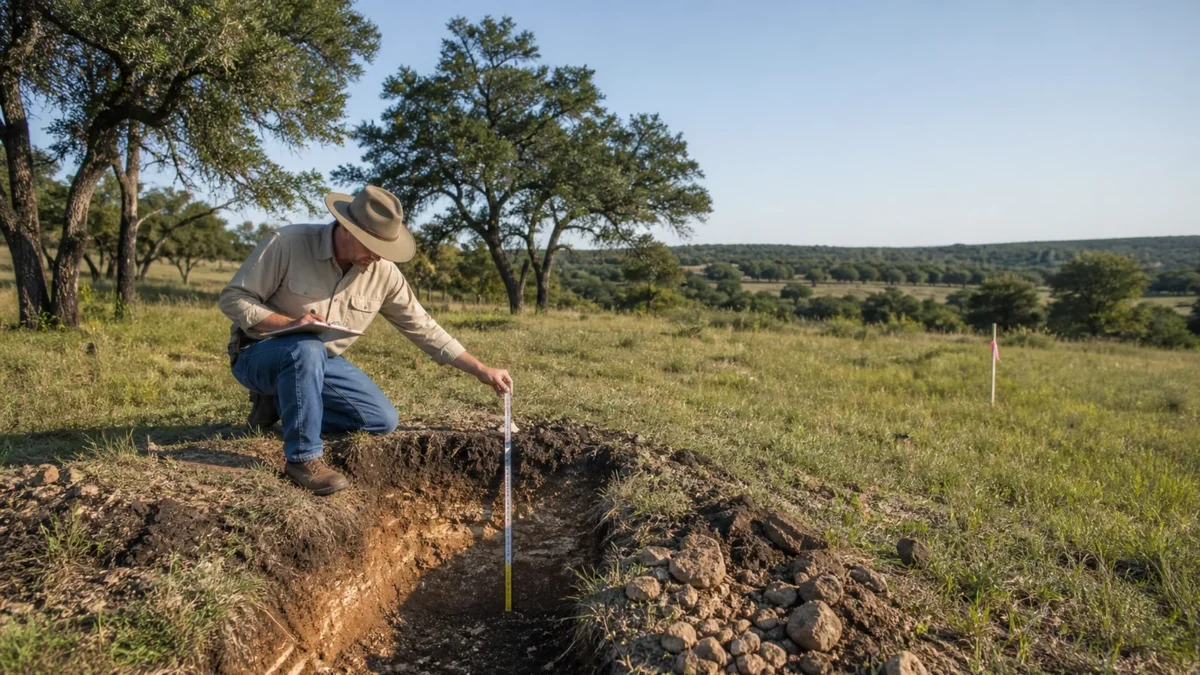
Start with the USDA NRCS Web Soil Survey, which maps your soils and estimates how much they grow. Then ask your county AgriLife Extension office or your local NRCS office to help with a number. AgriLife says those offices have forage guides for every county in Texas and can tell you how many acres it takes to carry one animal unit.
- Draw your boundary in Web Soil Survey and note the soil types.
- Subtract the house site, driveway, septic area and heavy woods.
- Ask Extension or NRCS for a stocking rate on those soils.
- Start light, and add animals only after a good year.
Texas A&M’s stocking rate guide describes exactly that: adjust the acres per animal unit up or down each year with forage production. Starting light also gives you a season to learn which cow is the escape artist. There’s always one, and she’s usually the friendly one.
What we’ve seen developing Murphy’s Dairy Ranch
Murphy’s Dairy Ranch is a working pasture first and a set of homesites second. The homesites just outside Mexia are mostly about 3 to 4.5 acres, flat and perc tested, behind two welded, concreted cattle-guard entrances off County Road 463. The pasture is still leased for cattle grazing, and buyers can choose to keep the cows on their land.
The deed restrictions allow residential, ranching and agricultural uses. Pigs are a no, which the cows took better than expected. The herd is famously curious about new people, so bring the truck slowly and expect a welcoming committee with no snacks and a lot of questions.
On a 3-acre homesite, the house, driveway and septic area take a real bite out of the grass. Plan on hay if you want a cow of your own, and use the pasture as a bonus, not the whole menu.
The groundwork is what makes a small herd practical. We built about 6,200 feet of new private road with a limestone base and drainage on both sides, because Texas rain likes to show up all at once. Water meters and Oncor power run along the frontage, and the plat was approved by the county septic authority. The cows still prefer to walk on the grass, which is rude, but fair.
There’s also a local rancher who has worked this land for decades, and we can pass along referrals for fencing and land work. You can see every homesite in the area on our Limestone County land for sale page.

Ready to run the numbers on a place of your own? Browse our ranch land for sale, and check each lot page for acreage, utilities and owner-financing terms.
Official resources
- TPWD: Livestock Management Recommendations, Post Oak Savannah and Blackland Prairie (PDF)
- TPWD: Wildlife Management Activities and Practices, Post Oak Savannah and Blackland Prairie (PDF)
- TPWD: Wildlife Management Activities and Practices, Edwards Plateau and Cross Timbers (PDF)
- TPWD: Wildlife Management Activities and Practices, Gulf Prairies and Marshes (PDF)
- TPWD: Trans-Pecos Habitat and Wildlife Management
- Texas A&M AgriLife Extension: Livestock for Small Acreage Landowners (PDF)
- Texas A&M AgriLife Extension: Stocking Rate, the Key Grazing Management Decision
- Texas A&M: Managing Livestock Stocking Rates on Rangeland (PDF)
- Texas A&M Rancher’s Reference Guide: Livestock Husbandry
- AgriLife Today: Keep Cattle Hydrated and Healthy
- USDA NRCS: Web Soil Survey
- Texas A&M AgriLife Extension: County Offices
- USDA Service Center Locator (NRCS offices in Texas)
- Limestone Central Appraisal District